


Explore Derivatives to Diversify your Portfolio
and reach your Financial Goals.

Options Chain
Options made easy with real-time Greeks, OI, and Volume.


Basket Order with Analyser
Single click Strategy execution with P&L analyser.

Derivatives Screener
Stay informed with real-time data on Positions, popular Trades, and top Gainers/Losers.

Technical Insights
Deepen your edge with Technical Analysis of derivatives.

Key Benefits
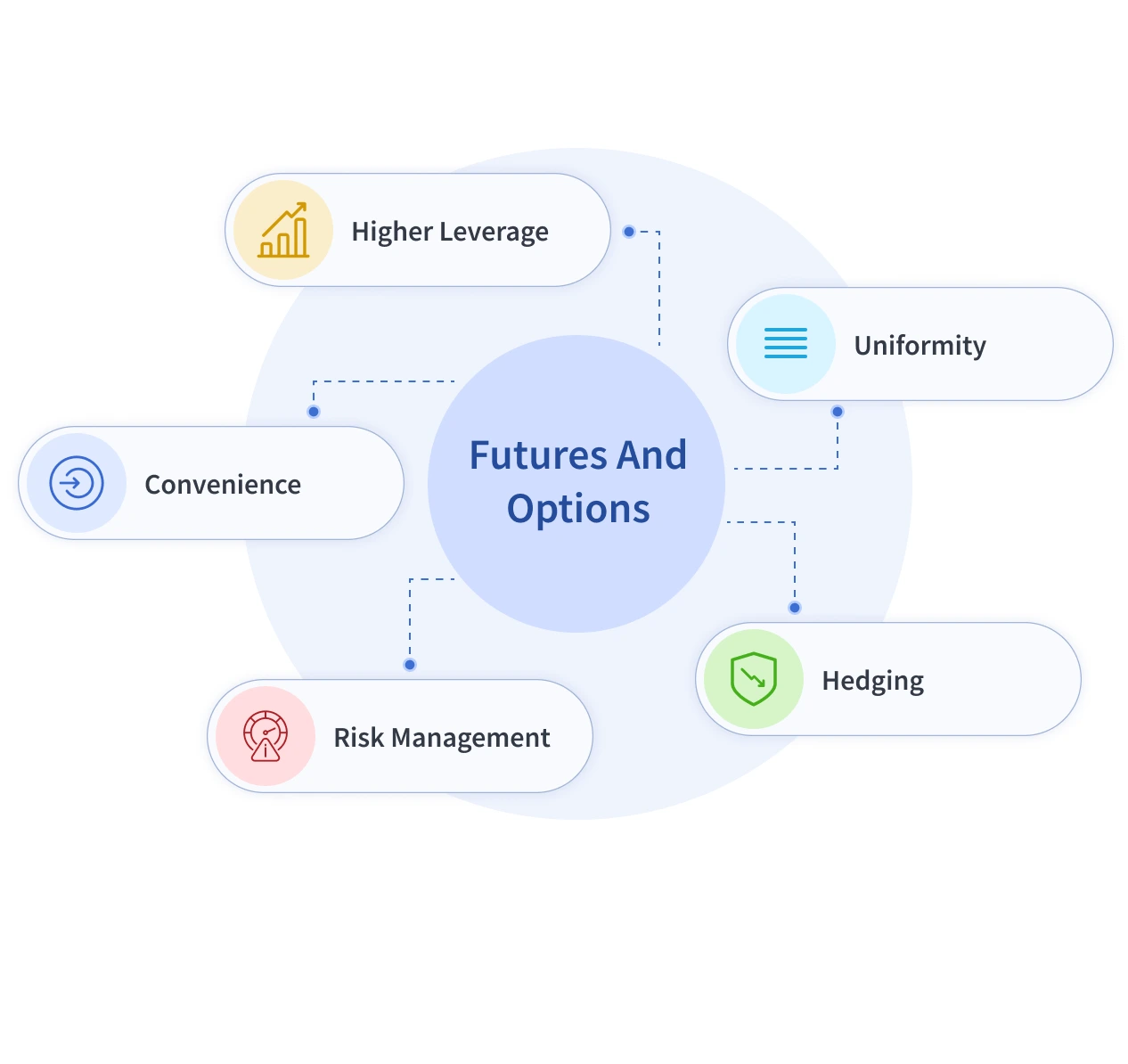

Higher Leverage
Control bigger trades with smaller capital outlay.
Uniformity
Contracts are uniformly structured with fixed quantity.
Hedging
Safeguards your investments by limiting downside risk without sacrificing opportunity
Risk Management
Identify and control risks to secure investments and limit potential losses.
Convenience
Enables broader market access for smaller investors.
Frequently Asked Questions
Futures and Options (F&O) are derivative financial instruments that derive their value from an underlying asset such as stocks, indices, commodities, or currencies. These contracts allow investors to trade on the future price movements of assets without actually owning them, providing opportunities for hedging, speculation, and portfolio diversification.
Futures contracts are legally binding agreements between two parties to buy or sell an asset at a predetermined price on a specific future date. Both buyer and seller are obligated to fulfill the contract terms upon expiry, making futures a commitment-based instrument.
Options contracts give the buyer the right, but not the obligation, to buy (call option) or sell (put option) an underlying asset at a predetermined price before or on a specific expiration date. The seller receives a premium and has the obligation to honor the contract if the buyer exercises their right.
The fundamental differences between futures and options lie in their obligations, risk profiles, and execution characteristics.
Aspect | Futures | Options |
Obligation | Mandatory for both parties | Right for buyer, obligation for seller |
Risk Profile | Unlimited profit/loss potential | Limited loss for buyers, unlimited for sellers |
Premium Payment | No upfront premium | Buyer pays premium upfront |
Execution | Mandatory on expiry | Optional exercise for buyer |
Margin Requirements | Both parties pay margin | Only seller pays margin |
Key Operational Differences:
Futures: Both parties must settle the contract regardless of market movements, creating symmetric risk profiles.
Options: Asymmetric risk where buyers have limited downside (premium paid) but unlimited upside potential, while sellers have limited upside (premium received) but significant downside risk.
Derivatives are financial contracts whose value is dependent on or derived from an underlying asset, group of assets, or benchmark. The underlying assets can include stocks, bonds, commodities, currencies, interest rates, and market indices. The price of derivatives fluctuates based on changes in the price of the underlying asset.
The underlying asset is the financial instrument from which a derivative contract derives its value. In F&O trading, underlying assets can be classified into several categories:
Equity Derivatives:
Individual stocks (e.g., Reliance, TCS, HDFC Bank)
Stock market indices (e.g., Nifty 50, Bank Nifty, Sensex)
Commodity Derivatives:
Precious metals (gold, silver)
Base metals (copper, aluminum, zinc)
Energy commodities (crude oil, natural gas)
Agricultural products (wheat, cotton, sugar)
Currency Derivatives:
Currency pairs (USD-INR, EUR-INR, GBP-INR)
Bond and Interest Rate Derivatives:
Government bonds
Interest rate futures
The underlying asset determines the contract specifications, margin requirements, and settlement procedures for F&O contracts.
The cash segment and derivative segment represent two distinct markets within the stock exchange ecosystem:
Cash Segment (Equity Market):
Involves immediate delivery and payment of securities
Full payment required for purchase
Physical ownership of shares transferred to demat account
No expiry dates for holdings
Limited to upward price movements for profit
Derivative Segment:
Contracts based on underlying assets without immediate delivery
Margin-based trading with leverage
Contract-based trading with expiry dates
Profit possible in both rising and falling markets
Settlement can be cash or physical depending on contract type
F&O trading is available to various categories of market participants, subject to eligibility criteria:
Eligible Participants:
Resident Indians: Individual investors meeting income and experience criteria
Non-Resident Indians (NRIs): Can trade through NRO non-PIS accounts with custodian arrangement
Hindu Undivided Families (HUF)
Partnership Firms
Corporate entities
Mutual Funds and Institutional Investors
Foreign Portfolio Investors (FPIs)
Restrictions:
Minors: Cannot trade in F&O as they cannot place intraday and derivative orders
NRIs from certain jurisdictions have specific restrictions
F&O trading hours is between 9:15 AM to 3:30 PM (Monday to Friday).
Lot size represents the minimum number of shares or units that can be traded in a single F&O contract. It ensures standardization and market efficiency by defining the contract specifications.
Contract value represents the total monetary worth of an F&O contract which is calculated as:
Contract Value = Lot Size × Market Price of Underlying
Example Calculations:
Nifty Futures: If Nifty is at 22,000 and lot size is 75
Contract Value = 75 × 22,000 = ₹16,50,000
Index F&O contracts are based on market indices like NIFTY or BANK NIFTY, while Stock F&O contracts are linked to individual company shares like Reliance or TCS. The key difference is in settlement and risk — index contracts are always cash-settled since you can’t “deliver” an index, and they tend to have lower volatility and lower risk of price manipulation. Stock F&O, on the other hand, involves physical settlement in India if held till expiry, meaning traders may need to actually deliver or take delivery of the shares, and these contracts are generally more volatile and require higher margins due to stock-specific risks.
To activate F&O (Futures and Options) trading, you need to submit certain documents to prove your income and trading ability. You can provide any one of the following as income proof: a bank statement from the last 6 months (showing an average balance between ₹10,000), salary slips from the latest 2 months (with monthly salary over ₹10,000), the latest Form 16 (with stamp/seal), last year’s ITR acknowledgment (showing total income more than ₹1.2 lakh), or a demat holdings statement (with a minimum portfolio value of ₹10,000). Additionally, you may need to provide a declaration of your trading experience, a net worth certificate for high-value trading, and a risk acknowledgment to confirm that you understand the risks of F&O trading.
Yes, F&O trading can be activated on existing equity accounts without opening new accounts.
F&O contracts follow a standardized expiry schedule set by the exchanges. Monthly contracts expire on the last Thursday of every month, while major indices also have weekly contracts expiring every Thursday. If any Thursday is a holiday, the expiry shifts to the previous trading day.
The expiry date is the final day when an F&O contract remains valid and can be traded.
On expiry day, F&O contracts go through an automatic settlement process with specific trader obligations. For index F&O, settlement is always in cash, all open positions are squared off at the final settlement price, which is calculated based on the weighted average of the index in the last 30 minutes of trading. There’s no physical delivery involved, only a cash adjustment of profits or losses. In contrast, stock F&O contracts involve physical settlement if held till expiry. In-the-money (ITM) options require actual delivery of shares, and futures positions must be settled by delivering or receiving the stock, with traders needing to maintain the full contract value as margin. The exchange handles the process by reviewing open positions, calculating the final settlement price, assigning delivery obligations, and completing either cash or physical settlement as applicable.
Settlement methods decide how F&O contracts are closed when they expire. In cash settlement, there is no exchange of actual shares, only the profit or loss difference is paid in cash. All index F&O contracts use cash settlement, making it a simple process with automatic adjustments based on the final price and no hassles like delivery. In physical settlement, actual shares are delivered. This applies to all stock futures and in-the-money (ITM) stock options, where traders must pay or receive the full contract value, it involves the real transfer of securities.
If traders don’t square off their F&O positions before expiry, the exchange settles them automatically. For index F&O, this means simple cash settlement, positions are closed at the final settlement price, and profits or losses are automatically credited or debited, with no further action needed. For stock F&O, it triggers physical settlement, meaning traders must deliver or take delivery of the actual shares, and the full contract value must be available as margin. Failing to deliver can lead to auctions and penalties. As expiry nears, margins usually increase, and traders face risks like sudden price swings or needing large funds for delivery, but the exchange manages the settlement process automatically.
The settlement price is the price used to close F&O contracts on expiry day. It is usually calculated using the volume-weighted average price (VWAP) of the last 30 minutes of trading for indices, while for stock F&O with physical delivery, the stock’s closing price is used.
Weekly expiry contracts are options that expire every Thursday, offering short-term trading opportunities. These contracts have a short duration, Weekly contracts are more volatile, reacting sharply to market movements, and they are commonly available for major indices like Nifty 50 and Bank Nifty.
Monthly expiry contracts are the standard type of Futures and Options (F&O) contracts and expire on the last Thursday of every month. These contracts give traders a longer period for market movements to play out, providing more time than weekly options.
Option moneyness at expiry determines what happens with the option contracts. In-The-Money (ITM) options have intrinsic value. For call options, this means the strike price is less than the market price, and for put options, the strike price is higher than the market price. These options are automatically exercised, and for stocks, physical delivery takes place. At-The-Money (ATM) options have a strike price close to the market price and usually have little or no intrinsic value, they may or may not be exercised depending on the market price. Out-Of-The-Money (OTM) options have no intrinsic value, call options where the strike price is above the market price and put options where the strike price is below the market price and these expire worthless without being exercised.
Physical delivery obligation means that certain Futures & Options (F&O) contracts require you to physically transfer the underlying shares when they expire. This happens mainly with stock futures and in-the-money (ITM) stock options at expiry. If you hold a long position, you receive the shares, and if you hold a short position, you must deliver the shares. For example, with stock futures, a long position means you have to buy and take delivery of the shares, while a short position means you have to sell and deliver them. For ITM call options, the long position takes delivery by paying the strike price, and the short position delivers the shares. For ITM put options, it’s the opposite, the long position delivers shares, and the short position takes delivery. To fulfill these obligations, you must pay the full contract value in cash, have free shares available if delivering them, and significantly higher margin requirements as expiry approaches.
Initial margin is the upfront amount of money or collateral that a trader must deposit before taking a position in the market. For derivatives (futures and options), the initial margin is the sum of the SPAN margin and the Exposure margin, both of which are also required upfront.
SPAN margin is a risk-based margining system called Standard Portfolio Analysis of Risk. It calculates the minimum funds a trader must keep upfront to cover potential one-day losses from futures and options positions. SPAN uses multiple simulated market scenarios considering price changes, volatility, time to expiry, and strike prices to estimate the worst-case loss in the entire portfolio rather than on individual trades. This dynamic system adjusts margin requirements based on portfolio risk.
Exposure margin is an additional margin collected on top of the SPAN margin to cover risks that the SPAN margin may not fully protect against. It acts as a safety buffer to protect against sudden and erratic market price swings or potential losses ‘At the money’ (ATM). This margin is charged upfront along with the SPAN margin to form the total initial margin an investor must pay to open a derivatives position.
Mark to Market (MTM) is the daily process of revaluing open futures and options positions based on the closing price of the day. It calculates the profit or loss from the change in the price of the underlying asset since the previous trading day. The resulting gain or loss is settled in the trader's account on the same day, ensuring that traders maintain enough margin to cover potential losses. This daily settlement continues until the position is closed.
Value at Risk (VaR) is a statistical measure used to estimate the potential loss in the value of a portfolio or a trade under normal market conditions over a specific period, usually one day, at a certain confidence level. It provides an estimate of the maximum loss one might expect to incur with a given probability, for example, a 99% VaR of ₹1 lakh means there is a 99% chance that losses will not exceed ₹1 lakh in a day.
Extreme Loss Margin (ELM) is an additional margin collected on top of the Value at Risk (VaR) margin. It provides a buffer to cover potential losses in extreme market conditions that go beyond the risks accounted for by the VaR margin.
A call option is a financial contract that gives the buyer the right, but not the obligation, to buy an underlying asset at a predetermined price called the strike price, on or before a specific expiry date. The buyer pays a premium for this right. If the asset's price rises above the strike price before expiry, the buyer can exercise the option to purchase at the lower strike price and potentially make a profit. If the price does not rise above the strike price, the buyer can let the option expire, losing only the premium paid.
A put option is a financial contract that gives the buyer the right, but not the obligation, to sell an underlying asset at a predetermined price called the strike price, within a specific time frame before the option expires. The buyer pays a premium for this right. If the asset's price falls below the strike price, the buyer can sell at the higher strike price, potentially making a profit. If the price stays above the strike price, the buyer can let the option expire, losing only the premium paid.
Options premium is the price that an investor pays to buy an options contract whether a call or a put. This premium is paid upfront to the option seller (also called the writer) and gives the buyer the right, but not the obligation, to buy or sell the underlying asset at a specific strike price within a fixed timeframe. The premium is determined by several factors, the difference between the asset’s current market price and the strike price (intrinsic value), the time left until the contract expires (time value), and how much the asset's price is expected to fluctuate (volatility). Option premiums are not fixed, they change with market conditions, time to expiry, and the demand for the option.
Intrinsic value of an option is the real or inherent, value of the option if it were exercised immediately. It represents the profit a trader would make by exercising the option at the current market price compared to the strike price. The intrinsic value cannot be negative if exercising the option is not profitable, its intrinsic value is zero.
The formula for intrinsic value differs for call and put options:
For a Call Option:
Intrinsic Value=max(0,Spot Price−Strike Price)
For a Put Option:
Intrinsic Value=max(0,Strike Price−Spot Price)
Here, the spot price is the current market price of the underlying asset, and the strike price is the fixed price at which the option holder can buy (call) or sell (put) the asset.
Time value as is the portion of an option's premium that reflects the additional amount a buyer is willing to pay over the intrinsic value because of the time left until the option expires. It represents the potential for the option to become more profitable as there is still time for the price of the underlying asset to move favorably. The longer the time to expiry, the higher the time value tends to be. As the option approaches its expiry date, the time value decreases and eventually becomes zero at expiration. Time value also accounts for factors like market volatility and the chance of future price movement.
It can be calculated as:
Time Value = Option Premium – Intrinsic Value
Moneyness describes the relationship between the option’s strike price and the current market price (spot price) of the underlying asset, showing whether an option is profitable to exercise.
There are three types of moneyness:
In-the-money (ITM): A call option is ITM if the strike price is less than the spot price, meaning exercising will yield a profit. For a put option, ITM means the strike price is greater than the spot price.
Out-of-the-money (OTM): A call option is OTM if the strike price is higher than the spot price, so exercising results in no profit. A put option is OTM if the strike price is less than the spot price.
At-the-money (ATM): When the strike price is equal to the spot price, the option is ATM, meaning it would neither make a profit nor a loss if exercised right now.
An F&O ban period is a temporary restriction placed on a stock’s futures and options trading when the total Open Interest of its F&O contracts exceeds 95% of the stock’s Market Wide Position Limit (MWPL). During the ban, traders cannot open new F&O positions in the affected stock, they can only close or square off existing positions. The ban remains in effect until the open interest falls below 80% of the MWPL, at which point the restriction is lifted. This rule helps prevent excessive speculation and potential manipulation in the stock’s price, protecting market integrity and investor interests.


